We're pleased to be hosting a book launch for two new books by professor Colton Fehr (University of Saskatchewan, College of Law): Rethinking Homicide: The Constitutional Case for Reform (McGill-Queen's University Press) and Cruel and Unusual: Section 12 of the Canadian Charter of Rights and Freedoms (University of Toronto Press).
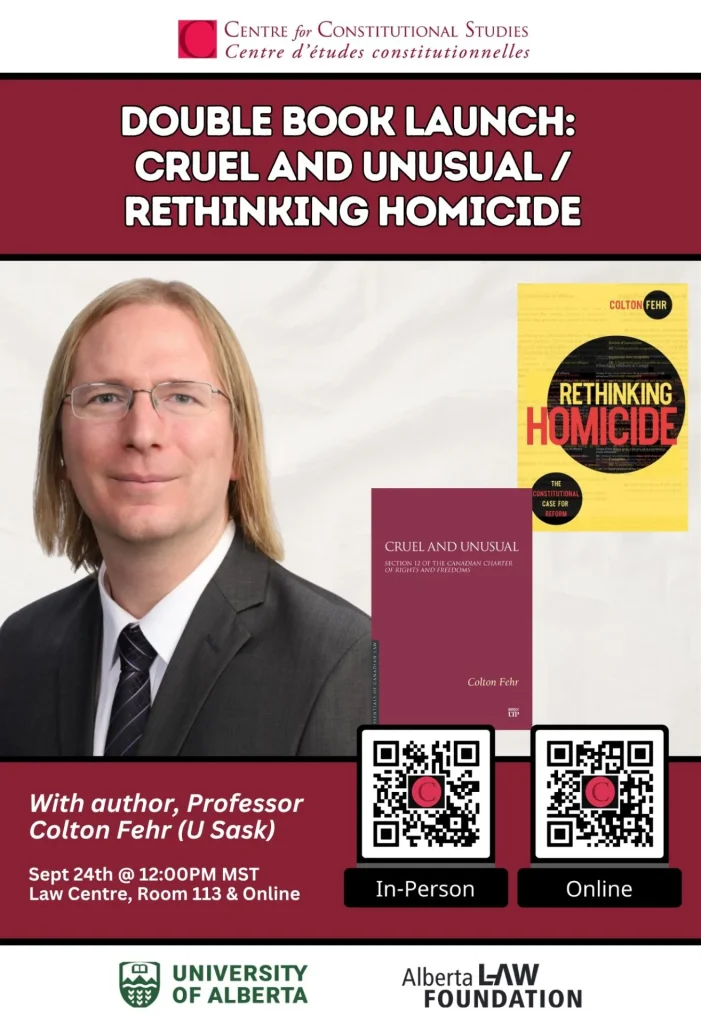
Book Synopsis: Rethinking Homicide: The Constitutional Case for reform (McGill-Queen's University Press, 2026)
Critics describe homicide law in Canada as outdated and unprincipled in application. While early jurisprudence compelled limited reform, constitutional challenges subsided near the turn of the twentieth century, and legislative amendments have been rare and piecemeal.
Rethinking Homicide makes a compelling case for constitutionally restructuring homicide law and considers how Parliament might respond. Colton Fehr contends that the distinctions between first- and second-degree murder and manslaughter unfairly label some offenders, challenges the infanticide provision, and explains why the provocation defence has no constitutional status and should be repealed. He also argues that murder’s exclusion from the duress defence is inconsistent with the principle prohibiting conviction for morally involuntary conduct. From that principle, Fehr develops a broader constitutional structure for substantive defences implicated by homicide offences. He further contends that the minimum sentences applicable to homicide constitute cruel and unusual punishment. In response, Parliament will have to choose between a sentencing safety valve and a diminished responsibility defence, with the former option being the preferable policy.
The arguments offered in Rethinking Homicide provide a timely and important contribution to criminal law. Scholars, judges, and lawyers alike will appreciate its much-needed contemplation of the Charter within this core area of criminal law.
Book Synopsis: Cruel and Unusual: Section 12 of the Canadian Charter of Rights and Freedoms (University of Toronto Press, 2026)
Cruel and Unusual presents an overview and critical discussion surrounding the judicial interpretation of section 12 of the Canadian Charter of Rights and Freedoms.
This book explains the various components of section 12 including the judicial development and application of the terms “punishment,” “treatment,” and “cruel and unusual.” It provides a rigorous discussion of the remedies available upon proving that the state imposed “cruel and unusual” consequences, as well as whether any law mandating such a draconian-sounding consequence may be justified under section 1 of the Charter. Colton Fehr puts forward various reform recommendations and criticisms of current doctrine. He contends that the judicial development of section 12 and its methodology for proving an infringement provide a principled framework upon which to consider a variety of issues that are sure to come before the courts including the consideration of the constitutionality of various minimum sentences and other methods of treatment used in Canadian prisons.
Written in a concise and accessible manner, Cruel and Unusual is tailored to both law students seeking to develop an understanding of this complex area of law and jurists seeking to apply and develop this important constitutional right.